Star Trek
Startrek.com
Tuesday, April 28, 2020
Startrek: Memory Prime
Wednesday, February 26, 2014
Emergecy Medical Holographic Program
Abbreviated EMH, it's a sophisticated holographic program mach 1. It was developed by Starfleet and used on most Federation ships. It was designed to provide short-term advanced assistance during emergencies in sickbay not replacing the medical officer. EMH Progam AK-1 is itd formal name. There has been four EMH programs in Starfleet history as of yet.
Spock gave McCoy the idea to form an EMH. McCoy said he rather die than be replaced.
Doctor Lewis Zimmerman was assigned to the task of creating the EMH at Jupiter Station Holoprograming Center. He designed them as the embodiment of medicine. The EMH mark 1 was programmed with ovee five million possible treatments from over 2000 medical references and the experience of 47 medical officers. It contains over fifty gigoquads of computer memory.
Friday, February 14, 2014
Kobashi Maru Scenario
Sunday, October 13, 2013
I'm a doctor, not a....
The running gag in the various Star Trek series in which a medical figure states, "I'm a doctor, not a...." was originally found in the film comedy The Kennel Murder Case. Only Dr. Krusher on Star Trek: The Next Generation, of all main cast doctors of five series, never said the phrase. Dr. Pulaski on Star Trek: The Next Generation the line, either, but she was not credited as a regular cast member.
Star Trek Trivia Calendar Sunday October 13, 2013
Sunday, October 6, 2013
Warp Factor Chart
Warp speed is the way starship speed is measured in Star Trek. It is a logarithmic scale, not linear. Warp 10 is infinite speed, and is the same thing as occupying every point in the universe simultaneously. Here is a chart that shows how fast each warp factor is, compared to the speed of light, and the distance to our nearest star, Alpha Centauri, which is 4.6 light years distant.
Warp Lightspeed Time to Centauri
1 1 5 years
2 10 6 months
3 39 2 months
4 102 18 days
5 214 9 days
6 392 5 days
7 656 3 days
8 1024 2 days
9 1516 1 day
9.2 1649 1 day
9.6 1909 23 hours
9.9 3053 14 hours
9.99 7912 6 hours
9.9999 199516 13 minutes
The numbers above have been rounded, and are based on the Star Trek Encyclopedia's data.
Star Trek major contributions
Star Trek has had a major impact on my life. It has shown me that whatever you can imagine will come true. It has been the seed of many of my writings as well as my projects.
I have taken a greater interest in outer space because of the shows. I cant wait for the new series to come out.
Wednesday, September 25, 2013
Stardates and how to get them
Using reference points established in Star Trek: The Next Generation, a mathematical fomula for converting stardates into standard calendar dates is possible. One full Earth year is 1,000 stardate units, so to figure out the date for stardate 41153.7 in the first season (year 2364) take the last three digits and decimal, divide by 1000 and multiple by 365 to get the day of the year, which in this case is 56th day, or February 25, 2364. Don't forget to factor in leap years, in which case the multiplier should be 366.
Monday, July 22, 2013
A Klingon death
StarTrek.com is saddened to report the passing of Victor Lundin, a character actor with a unique place in Star Trek history. Lundin, who passed away on June 29 at the age of 83, portrayed the very first Klingon on Star Trek: The Original Series. Most fans assume that Jon Colicos as Kor had that distinction in the episode "Errand of Mercy." However, Lundin's Klingon Lieutenant actually appeared on screen a few moments before Colicos' Kor.
Monday, March 4, 2013
First Generation tractor beams
They were first referenced in 1928. In essence they are light rays that both push and pull. There are electromagnetic forces at work, and possibly gravitons.
It's extremely common for more then one force of gravity to effect an object. An example is if you are holding a cup, your force is attracting it while the Earths force is also keeping the cup upright.
In 1986, "Optical Tweezers" were invented, which were able to pull objects with lights and lasers. The optical vortex bends light to change objects momentum. It traps light, absorbing particles because of heatis pushing out the center which is moving within the air.
Tuesday, February 19, 2013
7 wonders of the StarTrek Galexy
Startrek Magazine Winter 2012 issue 42
1) Bajorean Wormhole- This wormhole is called the Celestial Temple by the Bajorans.
2) The Dyson Sphere- This sphere is a whopping 200 million kilometers. It is built around a sun, and is one of the finest engineering feats known to exist.
3) The Nexus- This spatial phenomena causes dreams to become reality. But you better be careful what you wish for because it all comes with a price.
4) The Guardian of Forever- This ancient, glowing ring shaped rock is actually a portal used to travel through time as well as dimensions. All you have to be careful of is changing the course of history.
5) StarFleet headquarters- This is the headquarters where all the action begins. Located in San Francisco of Earth, you could tour it all if you happen to be in the area.
6) Great Domes of Qonos- This is one of the landmarks of the Klingon homeworld. When Worf was there for the first time he felt as if he was home. If you spend to long gazing at them, however, you run thevrisk of feeling as Worf did.
7)Unimatrix Zero- Take a break from reality, but be warned that you might be turned Borg while in here.
Saturday, February 2, 2013
Gene Roddenberry
Originally pitched StarTrek as "Wagon Train to the Stars." Wagon Train was a western tv series that ran on NBC (1957-62) and ABC (1962-65). Roddenberrys original name for the Enterprise was Yorktown. "Wagon Train to the Stars" is also a name of a novel written by Diane Carey in 2000 from Pocket Books Star Trek New Earth series.
From Trek Trivia Calendar February 1, 2012
Sunday, January 13, 2013
Computer Simulation Reality
What is real?
This question has plagued mankind for our whole existence. We could only perceive a fraction of our surroundings. What if our world is just a simulation of another reality. Nick Bostrom, oxford University philosopher is one of the lead minds studying this quandary. He asks if we create a universe simulation, we probably will create as many simulations as we can to learn more about our universe.
Silas R. Beane, Zorah Devodi and Martin J. Savage have set forth the lattice gauge and quantum chromodynamics (QCD) to help determine if we are living in a computer simulation.
There are four forces within our universe, which are electromagnetism, strong and weak nuclear forces and gravity. The Lattice Gauge Theory and QCD focus on nuclear forces, that hold subatomic particles together. The strongest of which has the shortest range.
Quantum chromo-dynamics explains the fundamental nature in four space time dimensions. High performance computers (HPC) enable this researchers to simulate small universes to study QCD. Lattice structures enable representation of the space time continuum. universes
Tuesday, September 11, 2012
Starfleet Planet Classes
Class A - Gas Supergiant Planets of this class are usually found in a star's outer or "cold zone". They are typically 140 thousand to 10 million kilometers in diameter and have high core temperatures causing them to radiate heat. Low stellar radiation and high planet gravity enables them to keep a tenuous surface comprised of gaseous hydrogen and hydrogen compounds.
Class B - Gas Giant Class B Planets are usually found in a star's outer or "cold zone". They are typically 50 thousand to 140 thousand kilometers in diameter and have high core temperatures but do not radiate much heat. Low stellar radiation and high planet gravity enables them to keep a tenuous surface comprised of gaseous hydrogen and hydrogen compounds.
Class C - Reducing Planets of this class are usually found in a star's "habitable zone". They are typically 10 to 15 thousand kilometers in diameter. They have high surface temperatures due to the "greenhouse effect" caused by their dense atmospheres. The only water found is in vapor form.
Class D - Geo Plastic Planets of this class are usually found in a star's "habitable zone". They are typically 10,000 to 15,000 kilometers in diameter. They have a molten surface because they have been recently formed. The atmosphere contains many hydrogen compounds and reactive gases. Class D planets eventually cool, becoming Class E.
Class E - Geo Metallic Planets of this class have a molten core and are usually found in a star's "habitable zone". They are typically 10,000 to 15,000 kilometers in diameter. Their atmospheres still contain hydrogen compounds. They will cool further eventually becoming Class F.
Class F - Geo Crystaline Class F planets are usually found in a star's "habitable zone". They are typically 10 to 15 thousand kilometers in diameter and have surfaces that are still crystalizing. Their atmospheres still contain some toxic gases. They will cool eventually becoming Class C, M or N.
Class G - Desert Planets of this class can be found in any of a star's zones. They are typically 8 to 15 thousand kilometers in diameter. Their surfaces are usually hot. Their atmospheres contain heavy gases and metal vapors.
Class H - Geo-Thermal Planets of this class are usually found in a star's "habitable zone" or "cold zone". They are typically 1,000 to 10,000 kilometers in diameter. They have partially molten surfaces and atmospheres that contain many hydrogen compounds. They cool becoming Class L.
Class I - Asteroid / Moon Planetary bodies of this class can be found in any of a star's zones. They are usually found in orbit of larger planets or in asteriod fields. They are typically 100 to 1,000 kilometers in diameter. They have no atmospheres. Their surfaces are barren and cratered.
Class J - Geo-Morteus Planets of this class are found in a star's "hot zone". They are typically 1,000 to 10,000 kilometers in diameter. They have high surface temperatures due to the proximty to the star. Their atmospheres are extremely tenuous with few chemically active gases.
Class K - Adaptable Planets of this class are usually found in a star's "habitable zone". They are adaptable for humanoid colonization through the use of pressure domes and other life support devices. They are typically 5,000 to 10,000 kilometers in diameter. They have thin atmospheres. Small amounts of water are present.
Class L - Geo-Inactive Planets of this class are usually found in a star's "habitable zone" or "cold zone". They are typically 1,000 to 10,000 kilometers in diameter. Low solar radiation and minimal internal heat usually result in a frozen atmosphere.
Class M - Terrestrial Planets of this class are found in a star's "habitable zone". They are typically 10,000 to 15 thousand kilometers in diameter. They have atmospheres that contain oxygen and nitrogen . Water and life-forms are typically abundant. If water covers more than 97% of the surface, then they are considered Class N.
Class N - Pelagic Class N planets are usually found in a star's "habitable zone". They are typically 10,000 to 15 thousand kilometers in diameter. They have atmospheres that contain oxygen and nitrogen . Water and life-forms are typically abundant. If water covers less than 97% of the surface, then they are considered Class M.
Class S - Near Star Planets of this class are usually found in a star's "cold zone". They are typically 50 million to 120 million kilometers in diameter and have high core temperatures causing them to radiate heat and light. These are the largest possible planets, because most planetary bodies that reach this size do become stars.
Class T - Gas Ultragiant Planets of this class are usually found in a star's "cold zone". They are typically 10 to 50 million kilometers in diameter. They have high core temperatures causing them to radiate enough heat to keep water in a liquid state.
Class Y - Demon Class Y - Demon Planets and planetoids of this class can be found in any of a star's zones. They are typically 10,000 to 15 thousand kilometers in diameter. Atmospheric conditions are often turbulent and saturated with poisonous chemicals and thermionic radiation. Surface temperatures can reach in excess of 500 K.
Starfleet Note: Communication is frequently impossible, and transport may be difficult. Simply entering orbit is a dangerous prospect. No known environment is less hospitable to humanoid life than a Class Y planetary body.
Yeremiah Hardt
Yeremiah@aol.com
Friday, June 29, 2012
Making of history
September 8, 1966 was the day that changed science fiction as well as science as a whole forever. A man named Gene Roddenberry was the cause of this drastic change within the history of mankind.
"Space, the final frontier. These are the voyages of the Starship Enterprise. Her five-year mission: To explore strange, new worlds; to seek out new life and new civilizations; to boldly go where no man had gone before...."With these words a new era began.
That day thirty years ago, it has marveled humankind as a whole though television shows, best selling books as well as movies.
Wednesday, April 25, 2012
Universal Translater
The Universal Translator of today is not perfect. They make mistakes a four year old wouldn't make. This is because vocabulary is always changing and there are different dialects of languages.
Plus there is no accountablity for body language.
Google is rapidly improving these gadget. Over the past decade there were much improvement. It adapts easier to changing vocabulary. They now deal with the spoken word rather then the written word as they have in the past.
Some other, less reliable Universal Translator programs are SpeechGear, Sayitti, and Jibbigo. However these programs, like Google are no where near as perfect as the ones on StarTrek. For one thing, a good dataplan is required for the usage of the Universal Translator, because every word is going back and forth to the tower. Since some countries language depend on the season, region, and countries ingredients of foods they are extremely difficult to translate.
Thursday, June 30, 2011
Teleportation
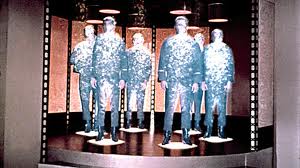
In 1970 Stephen Hawking’s was struggling with Einstein’s theories and had trouble linking them to quantum mechanics
Information has been teleported in two separate atoms about a yards distance in January of 2009. This was a milestone in quantum information processing. The polarization of photons transferred from one place to another without the aid of a physical source was what made this possible.
We are now able to transport over a meters distance. This works because of a quantum phenomenon called entanglement.
Quantum Mechanics is waves of information, which are like Alice in Wonderland going down the Rabbit Hole.
Yeremiah Hardt
yeremiah@aol.com
Monday, June 27, 2011
Prime Directive
This is Starfleet’s general Order 1. It is the most important and binding principle about no-interference in other planets cultures, internal affairs, development and progression. Starfleet Captains have to justify their actions in going against this in a court of law.
Yeremiah Hardt
yeremiah@aol.com
Friday, March 11, 2011
ST: Equation
James Tibereus Kirk was a more physical captain then Jean Luc Picard. At the same time Spock was more intellectual as Riker was more physical. So this equaled the equation of brawns vs. brains. That equation is always in existence.
Yeremiah Hardt
yeremiah@aol.com